Aurora
How it was built.

THE INSTRUMENT

J.R. Norman was a physicist.

The kind of man who could pick up a coat hanger, the extruded steel kind, and say to his son: do you realise that started as a flat piece of metal?

He wasn’t showing off. He was doing what came naturally. Looking at an ordinary object and seeing the entire process behind it. The material, the forces, the sequence of decisions that had turned one thing into another. And then, almost inevitably, asking whether it could be improved.

Mark Norman grew up watching his father think like this. It left a mark.

"He'd look at something and think: I can improve that. I suppose I have a similar point of view. You see something and think, what can we do with that?"

J.R. Norman never built a piano. But Aurora would not exist without him.

THE BRIEF

By the time Mark came of age, Edelweiss had spent decades restoring some of the finest pianos ever made.

By the time Mark came of age, Edelweiss had spent decades restoring some of the finest pianos ever made. Taking them apart. Understanding every component at the level of material and physics. Putting them back together better than they had arrived.

That knowledge accumulated. Fifty years of it. And it produced a particular kind of clarity about what a piano built specifically for the home actually needed to be.

In 2020, Mark sat down and wrote four points.

Point four turned out to be the hardest. The components needed to build a piano of this ambition had not been manufactured in Britain for decades. The industry had moved. The factories had been repurposed. What had once been a thriving domestic trade was now a memory.

Edelweiss decided to bring some of it back.

“We questioned whether we would even manage this. But when we thought about it, we took courage.”

Why We Built Aurora

THE FRAME

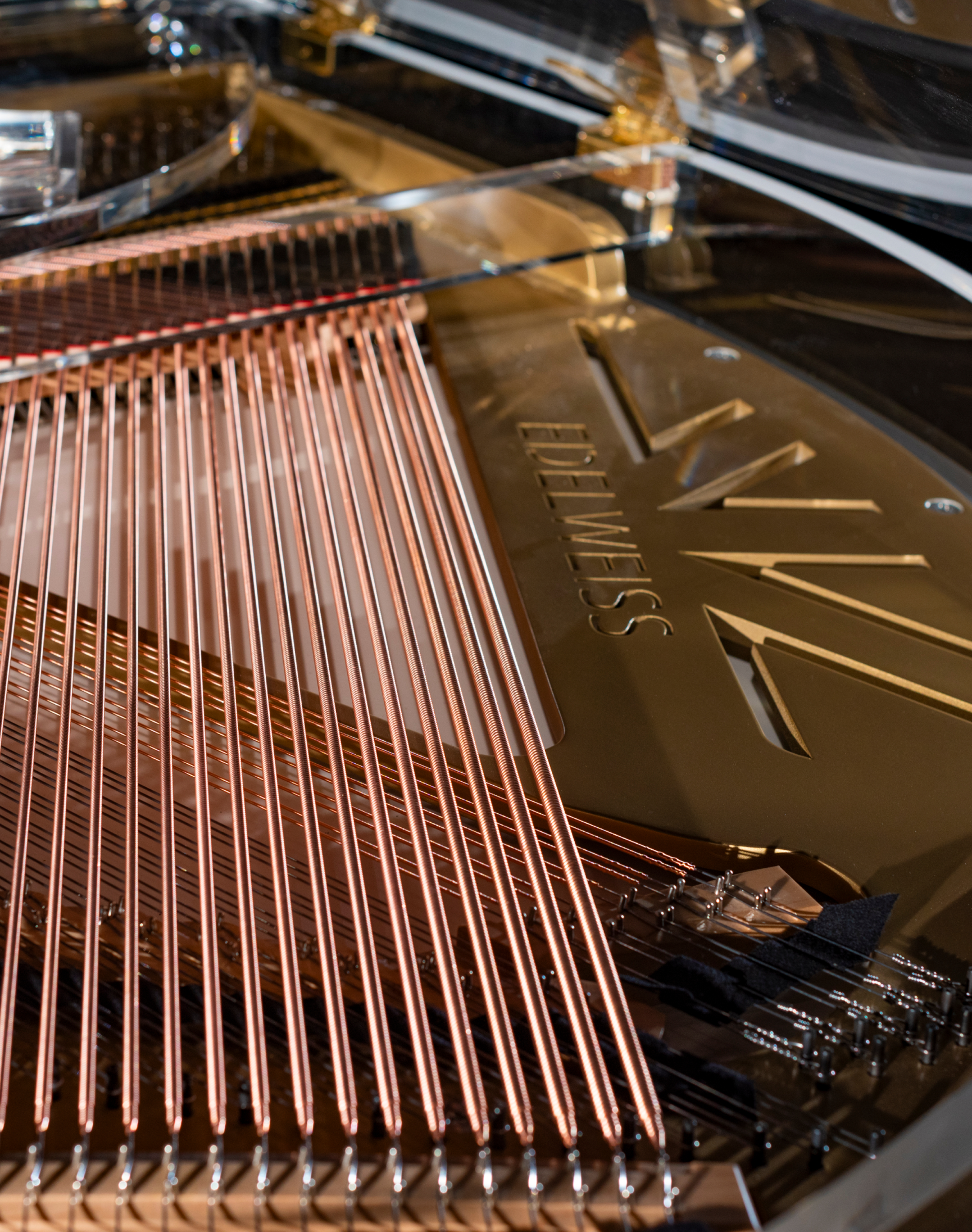
The piano frame is the structural heart of the instrument. It holds the strings under tension.

In Aurora, that tension runs to between eighteen and twenty tons.
Traditional piano frames are cast iron, poured hot in a foundry. The foundries that once did this work in Britain no longer exist in the same way. So Edelweiss did something the piano industry had not previously attempted. They designed a welded steel frame instead.
Not a compromise. A reinvention.

The Aurora frame is barless. Where traditional frames use cross-beams to join the two sections, Aurora has none. The space those bars would have occupied is given entirely to the action, the mechanism that translates the pianist’s touch into sound. Unrestricted. Precise. Responsive to the lightest intention.

Before a single piece of steel was cut, Mark ran finite element analysis on the design. Modelling the load computationally. Testing whether the structure would hold under twenty tons of tension before it existed in metal.

“I’d never done it before on a project like this. But I had to understand it well enough to drive it. That was the challenge.”

The barless frame is covered by patent. Cast iron frames have been the standard in piano making for over two hundred years. For Aurora, Edelweiss found something better.

Aurora — The Frame

THE SOUNDBOARD

The soundboard is where a piano's voice lives.

 It is the surface that vibrates in response to the strings and turns mechanical energy into sound. Getting it right is, in many ways, the whole problem.

Aurora’s soundboard begins as solid Alpine spruce. Harvested from forests high enough in the Alps that the cold slows the growth to almost nothing. Where a tree might add a millimetre of width in a year. Where decades of slow, patient growth produce a grain so consistent and so dense that it has no equal as a material for acoustic resonance.

This is the same timber that has been used in fine instrument making for centuries. Edelweiss sources it carefully.

But the construction of Aurora’s soundboard goes further than the material. Each side is overlaid with a layer of spruce veneer. The angle at which that veneer is applied determines everything about the acoustic result. Perpendicular to the grain and the sound suffers. Parallel and the resistance to splitting is compromised.

Through extensive testing, Edelweiss found a third angle. One that enhanced the sound beyond even a solid soundboard, while giving the construction a resistance to splitting that makes Aurora viable in the most demanding environments. Superyachts. Desert locations. Mountain chalets. Anywhere humidity and temperature push a conventional soundboard to its limits.

The angle itself is not published. It is proprietary to Edelweiss and it will stay that way.

Aurora — The Soundboard

THE FLOATING SOUNDBOARD

Every piano soundboard is glued around the rim of the instrument. This is not a convention. It is considered a structural necessity.

Aurora’s is not.

A section of the Aurora soundboard, closest to the rim, is left free. Unglued. Floating. The result is a resonance in that section that a fixed soundboard cannot produce. A ring. A sustain. A projection of sound that has no right to come from an instrument of this size.

This is the second patent.

Mark demonstrates it simply. A tap on the fixed section. A tap on the floating section. The difference is immediate and audible. The floating section rings where the fixed section is silent.

It is, in the most literal sense, the secret of why Aurora sounds the way it does.

Aurora — The Floating Soundboard

THE ACTION

The action is the mechanism that sits between the pianist's fingers and the strings.

Eighty-eight keys. Thousands of moving parts. Every one of them subject to the conditions of wherever the piano lives.

Aurora’s action uses carbon fibre composite bushings throughout. The decision came from experience. Edelweiss builds pianos that travel. Superyachts, where humidity is constant and salt air is corrosive. Mountain chalets, where temperature swings are extreme. Desert locations, where the air is so dry that conventional materials seize.

Wood, under those conditions, moves. It swells. It contracts. It sticks.

To test the carbon fibre bushings, Mark’s team submerged them in a tank of water. They left them there for two months.

After two months, the bushings were still moving. Still functioning. The felt had softened but the mechanism itself was unaffected.

Wooden parts placed in the same tank seized within thirty minutes.

“It’s very, very consistent. It doesn’t seize up with time.”

Aurora’s action will outlast almost any environment its owner can place it in.

THE MOUNTAIN

None of this was straightforward

None of this was straightforward. There were dead ends. Designs that didn’t work. Manufacturers who couldn’t deliver. Moments when the curtains seemed to be everywhere and the sensible thing would have been to stop. Mark has a way of thinking about those moments.

“I always think of it like a mountain. I’ve never climbed a mountain in my life, but you can look up and see a way. And if you work it out, you think: yeah, we should be able to get to the top. I don’t know exactly how, but from past experience, we should be able to do it. That’s what you have to hold onto.”

One in ten designs are good. That is not a confession of failure. It is a description of how serious design actually works. The willingness to discard nine ideas for every one worth keeping is what separates an instrument like Aurora from everything that surrounds it.

J.R. Norman would have understood that immediately.

THE RESULT

Aurora holds two patents

It was built using engineering processes the piano industry had not previously attempted. It sounds larger than its size should allow. And it is made, entirely, in Cambridge.

Serious pianists who sit down at Aurora rarely talk about anything else afterwards.

That is not a claim. It is what keeps happening.

The wider world

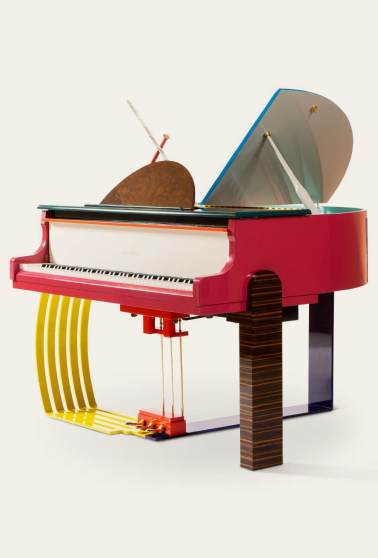
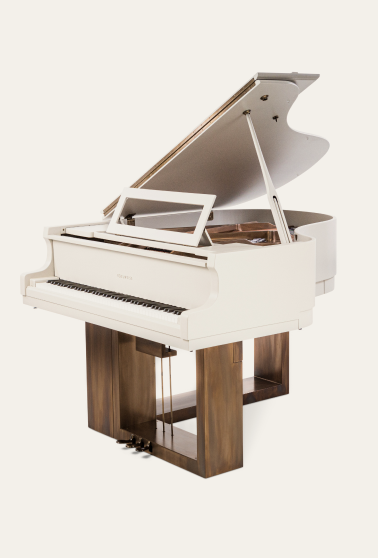
The world’s smallest grand piano.

The grand piano, in its full form.