

The keys move. The hammers strike the strings. The sound is entirely live. To anyone in the room, it is indistinguishable from a performance.
The technology has existed in various forms for over a century. What has changed is the precision, the invisibility, and what it means to live with one.
At Edelweiss, self-play is fitted as standard to every piano we build. Not as an upgrade. Not as an optional system. Standard, at every price point.
In a traditional acoustic piano, a pianist presses a key. The key pivots on a central balance rail. The back of the key rises, a hammer strikes a copper string, and a note sounds. The character of that note, its volume, its sustain, its weight, is determined entirely by the speed and force of the keystroke.
A self-playing piano replicates that process without the pianist.
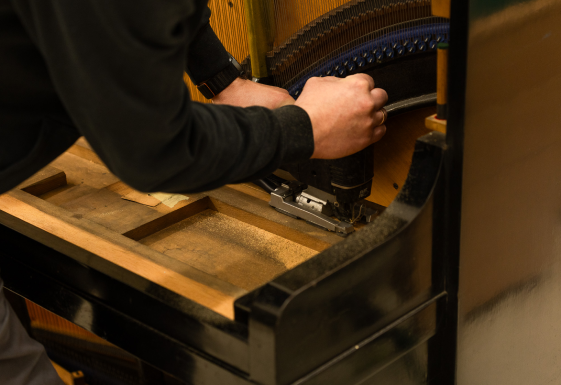
Precision electromagnetic solenoids sit beneath the keys and push each one from below. The key pivots on exactly the same balance point. The hammer strikes the string in exactly the same way. Each solenoid is calibrated to over 1,800 gradations of force per note, giving the system the same expressive range as a skilled human pianist.
The mechanism is completely invisible. There are no visible components, no boxes, no cables in view. A single power connection is all that is required. The piano looks and plays manually exactly as it always would.
MIDI technology communicates wirelessly from an iPad to the instrument. Select a piece. Press play. The piano performs.
The original player piano used pneumatic mechanisms and paper piano rolls to trigger notes. Pianola, Ampico, Duo-Art, these were the dominant systems of the early twentieth century, remarkable for their time and now largely of historical interest.
Modern player piano systems, sometimes called piano player systems or self-play systems, use MIDI recording and electromagnetic actuation instead. The result is dramatically more expressive, more reliable, and entirely concealed within the instrument.
Edelweiss self-play sits at the top of this category. The system is fitted and calibrated in our Cambridge workshop. The music library contains 1,000 pieces as standard, expandable to 5,000. Bespoke recordings can be commissioned for any piece, any artist, made exclusively for a single instrument.
The sound is not digital. It is not reproduced through speakers. It is a fully acoustic grand piano playing itself. That distinction matters enormously in a room.
Self-play can be fitted to grand pianos, baby grand pianos, and upright pianos. The mechanism differs slightly between formats but the principle is identical: invisible actuation, acoustic sound, wireless control.
Every Edelweiss grand piano, including the Sygnet baby grand and the full-scale Flügel, comes with self-play fitted as standard.
For upright pianos, Edelweiss also produces a transparent upright with self-play included.
Many of the finest pianos in Britain sit silent. Inherited instruments, pianos bought for children who grew up and moved away, pianos kept for the way they complete a room. Reborn is the Edelweiss service that returns them to life.
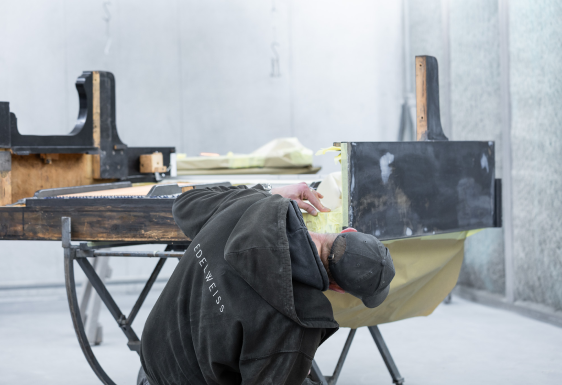
Our Cambridge team fits invisible self-play into existing acoustic pianos of almost any make and age. The touch, tone and character of your instrument are unchanged. It simply gains the ability to perform itself.
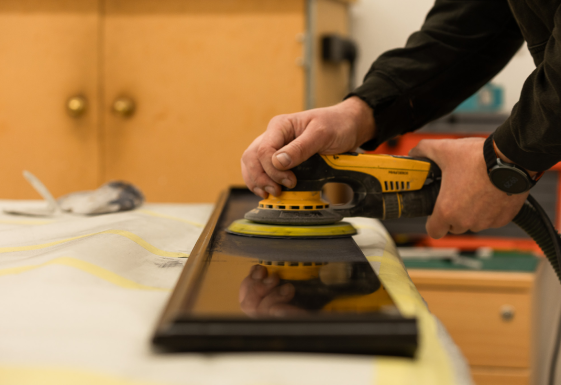
For owners who want to go further, the piano can also be refinished in a new colour as part of the same commission. The first Reborn instrument, an 1895 upright finished in black and warm blush, is on permanent display at Harrods.
Yes, without any change to the action or feel. The solenoids sit beneath the keys and push from below. They do not interfere with manual playing in any way. You can also play alongside the self-play system simultaneously.
