HOW DOES A SELF-PLAYING PIANO WORK?
It seems so magical: you select the song you want on your iPad, hit play and your piano bursts into life! But how does a
Listen as one of our customers explains how their lovely Bechstein Piano was sitting in there living room doing nothing- not being played and just collecting dust.
They reached out to us – we installed the self-play system for them and 6 months later their piano was returned.
Since that point they almost daily have the piano on self-play filling their home with beautiful live music.
Even better, when their Grandchildren visit it inspires them to get into music and they are hoping that their grandchildren will take up music – or even piano in the future!
Watch our customer testimonial below find out more!
Here at Edelweiss Pianos we build new pianos in our workshops in Cambridge, UK. All Edelweiss Pianos come as standard with our Virtuoso Self Play System.
However, we also provide a service which allows you to add our Virtuoso Self Play system to any brand of piano – not just an Edelweiss!
This service is carried out by our sister company – 1066 Pianos. You can find out more about this service here: https://www.1066pianos.com/retrofit-self-play
So if you own an old, acoustic grand piano which you may have inherited or unsure on what to do with it – you can bring it to life with our self-play system!
This video is shows you our self-play system and the process involved in making your old (or new) acoustic grand piano self-playing!
Subject to an assessment and appraisal to confirm, we can most certainly fit your piano with Self-Play.
We will initially request some photographs and piano details to allow our team to assess and provide a guide of costs with all the optional extras available to you.
2. What Brands Of Pianos Have You Fitted Self-Play To Before?
Nearly every brand of piano on the market we have fitted our self-play system too.
Bechstein, Bosendorfer, Steinway, Pleyel just to name a few.
If you are unsure – if you let us know the brand of your piano we will confirm with you if self-play has been successful installed on it before.
2. What Brands Of Pianos Have You Fitted Self-Play To Before?
Nearly every brand of piano on the market we have fitted our self-play system too.
Bechstein, Bosendorfer, Steinway, Pleyel just to name a few.
If you are unsure – if you let us know the brand of your piano we will confirm with you if self-play has been successful installed on it before.
3. What about if my Piano is antique or not a known manufacturer?
Our team of experts are able to fit self-play to a majority of pianos. Not only that, but our fitting system includes any works to improve your piano tone and manual play.
The self-play will only replicate as well as the piano plays manually and therefore often we undertake some additional work on the piano to improve its performance capability.
This is normally just regulation and voicing and checking up of the structure and set up unless the piano is very tired when small works or sometimes rebuilding is required.
4. If I have Self-Play installed can I still play the piano normally or does it affect how easy it is to play the piano?
Our Self-Play system makes no difference at all to the manual playability of your piano. The solenoids that operate the keys push the keys up from the back, and are just sitting waiting to work without interfering with the playing at all.
In fact, you can even play along with Self-Play at the same time! It’s a great tool for practising exam pieces, playing alongside the virtual pianist playing to improve and to perfect timing. Ask about our added extras such as Record and Playback.
Listen to Ross Norman, our Piano Consultant, show a TV crew how a Self-Play Piano works.
5. Will Installing Self-Play Harm My Piano?
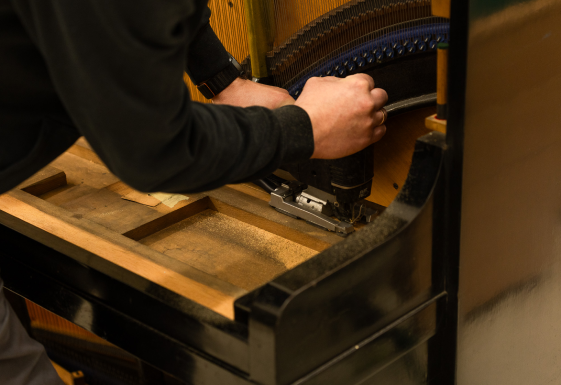
Not in the slightest. The only physical change to a grand is a small hidden slot for the solenoids and for an upright a similar adjustment. There is no harm or damage to the piano itself, just music and fun!
5. Can I adjust the volume of my piano when on Self-Play?
Yes, this is one of the great features of our Self-Play system. There is a volume slide on the iPad for the individual song level and you can also set overall volume, and balance with the accompaniment with ease
6. How Do I play music on my piano? Do I need an iPad or can I play it from my phone?
We always supply a dedicated iPod or iPad for control and music storage or you can now use the MyEdelweiss App if you have an Apple device.
7. Is the Self-Plasy system noticeable? Will it ruin the look of my piano?
Our Self-Play fits seamlessly in with your piano. No boxes or cables, just one 13A power cable that can be hidden down the leg or lyre.
Listen as Mark Norman, our Creative Director, explains where the Self-Play system is fitted to a piano.
8. Do these systems affect the tone, action, integrity of value of the instrument itself?
No, the tone, action, integrity and value of the piano are only enhanced. It is good for a piano to be regularly played and with normal maintenance playing will keep it in better condition than if left dormant.
Integrity-wise, the true tonal characteristics, the individual touch and sound, what’s special and you love about the instrument will be preserved and enhanced by what we do.
9. Can you add the self-play system to my piano at my house or does my piano need to come to your workshops in Cambridge?
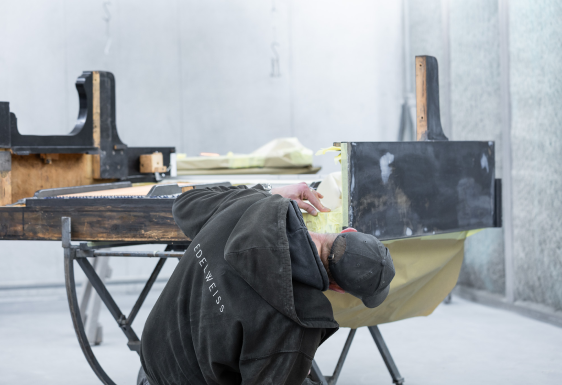
To retrofit our Self-Play to the best standard it must come into our Cambridge workshop. It’s a big job, taking 2 to 4 weeks to complete. We organise collection and return and can even drop in a hire piano in the meantime.
10. Is the System Easy to Use and Set-up?
It is very simple, with clear instructions and a very sympathetic, understanding, friendly and dedicated help line if you have any questions.
10. What Music comes as standard with the self-play system?
As standard you get a library of 1000 songs which consists of a mix of classical pieces to jazz to piano covers of modern pop songs.
You can upgrade to our 5000 song library if you wish.
11. What does it roughly cost to get my piano fitted with self-play?
An typical cost for adding self-play to your old or antique piano will be between £10,000 and £15,000.
12. What additional extras does your self-play system offer?
In addition to the standard system we can also offer a Record and Playback feature. This is particularly useful if you like to play and perform or are learning the piano. The feature allows you to play back performances or treasured memories.
Our SilentPlay feature can be fitted to virtually any piano too with very few exceptions. A mute rail switches off the acoustic piano and an optical midi rail hidden under the keys gives you a full electric piano experience.
You can ask about these additional features when you enquire.
Before exploring the technicalities of the self-play piano mechanism itself we need to first understand the basics of how any acoustic piano works.
With any acoustic piano, a pianist presses down a key causing the hammer to strike the string and sound a note. The controlling force of how loud or soft, how staccato or sustained this note sounds, is the strength and speed with which the pianist plays the key. The animation below shows a simplified cross section of a grand piano action being played by a pianist.
It is important to see that the key is pivoting on a central rail, known as the balance point, and when in its fully depressed position, the back of the key is raised from the key bed. It is this pivot motion that enables a totally concealed self-play system to bring any piano to life!
THE SELF-PLAY WORKINGS
Instead of a pianist, the Edelweiss Self-Play System uses electromagnetic solenoids to push that back to the key up from underneath – the front of the key presses down in exactly the same way causing the hammer to strike the string and sound a note.
This time, the controlling force is the strength and speed with which the solenoid pushes the key up, and this is very precisely controlled with every solenoid having just over 1,800 gradations of ‘force’ when playing each key. With normally one solenoid for each note on the piano, that is a total of 158,400 touch variations to be calibrated for every song you choose to have your piano play for you!
Below is an example of 3 demonstrations settings.
Read more about how a self-playing piano works below:

It seems so magical: you select the song you want on your iPad, hit play and your piano bursts into life! But how does a