



A piano rarely enters a room quietly.
Even before a single note is played, it begins to shift something intangible — the weight of the space, the direction of attention, the way people move within it. Conversations soften. Sightlines adjust. The room, almost instinctively, reorganises itself around the instrument.
For Kelly Wearstler, whose work has long explored how objects influence the atmosphere, that kind of visual weight is not incidental. It’s the starting point.
Her interiors have always been composed with a sense of tension and rhythm — materials layered with intent, forms positioned to create both contrast and harmony. A piano, in that context, is never just functional. It is sculptural. Architectural. Alive within the room.
This is what makes the idea of a piano so compelling within her world. Not as an addition, but as a force. Something that doesn’t simply sit within a space, but quietly redefines it.
Kelly Wearstler doesn’t design rooms to be observed. She designs them to be experienced.
Her work often begins with a feeling rather than a form — a mood, a tension, a certain kind of energy she wants the space to hold. From there, the room unfolds. Objects are introduced not simply for function or decoration, but for the way they alter perception. How they draw you in, slow you down, or create a moment of pause.
There is an instinctive quality to it. A willingness to let contrast exist without resolving it too quickly. Spaces feel collected rather than assembled, as if they’ve evolved over time instead of being fully predetermined.
Travel has shaped much of that perspective. Hotels, in particular, have influenced how she thinks about interiors as lived environments — places that carry emotion as much as they carry design. The way a lobby can feel expansive yet intimate. The way a room can quiet the mind without ever feeling minimal.
There is something deliberate about the moment a designer chooses to create an object from the ground up.
For Kelly Wearstler, whose work has largely lived within interiors, architecture and hospitality, designing a piano introduces a different kind of challenge — one that sits between furniture and sculpture, but also carries the technical precision of a musical instrument.
With Timbrá, her piano design created in collaboration with Edelweiss, this is not a surface-level reinterpretation. It is a complete design exercise, where form, structure and presence are considered from the very beginning.
The timing feels considered. In contemporary spaces, the role of the piano has been evolving. No longer confined to formal settings or occasional performance, it is increasingly positioned as part of the overall design language of a room — something that contributes visually and spatially, even before it is heard.
That makes it a natural extension of Wearstler’s world. Her work has consistently explored how objects shape atmosphere, and the opportunity to design a piano allows that thinking to operate at a different scale — one where proportion, material and placement all play a role in how a space is experienced.
Rather than adapting an existing form, Timbrá reflects a rethinking of what a piano can be. An instrument, certainly, but also a fully considered design object — one that is conceived as part of a space, not simply placed within it.

Some designs begin with a sketch. Others begin with a point of view.
Timbrá, the Kelly Wearstler Edelweiss piano, emerges from the intersection of both — a meeting of creative direction and technical craft, where the intention was not to decorate an existing form, but to define one from the outset. The shared process brings together Wearstler’s sculptural approach to design with Edelweiss’ expertise in building bespoke, self-playing grand pianos, resulting in something that feels considered at every level.
The name itself carries a certain weight. Timbrá evokes tone, resonance, and the subtle character of sound — not just how a note is played, but how it is experienced within a space and how the Timbrá sounds. It signals that this piano is as much about atmosphere as it is about performance.
From the earliest stages, the focus was on creating a piece that could hold its own within a room, whether in silence or in motion. Proportion, materiality and form were developed in parallel with the instrument’s engineering, allowing the design to feel integrated rather than applied.
What emerges is not simply a partnership, but a shared language. One that moves between design and music, object and experience — where the piano is conceived not only as an instrument, but as a defining statement within the space it inhabits.
Timbrá is defined as much by what it removes as what it introduces.
The form steps away from the visual weight often associated with traditional grand pianos. Lines feel cleaner, more intentional. Surfaces are resolved with a sense of precision, allowing the silhouette to read clearly within a space rather than relying on ornament to hold attention. There is a balance here — something grounded, yet visually light.
That sense of refinement is carried through its construction. Built from layered birchwood veneer, the piano reveals a quiet complexity beneath its surface — a material choice that brings both strength and subtle variation in tone. The layering introduces depth without excess, allowing the structure to feel considered from the inside out.

Each piece is handcrafted by Edelweiss’ team in Cambridge, where advanced engineering meets a more traditional, hands-on approach to making. It’s a process that doesn’t announce itself, but you sense it in the finish — in the way edges resolve, in the consistency of the surface, in how the piano holds light.
Material, here, is not decorative. It shapes how the object is experienced.
As light moves across Timbrá throughout the day, it reveals different qualities — at times more architectural, at others softer, almost understated. This shifting quality is what allows the piano to sit comfortably within a space, adapting to its surroundings without losing its identity.
Placed within a room, it doesn’t overwhelm. It anchors. The eye returns to it naturally, not because it demands attention, but because it feels resolved — as if it belongs exactly where it stands.
A collaboration like this only works when both sides are willing to meet in the same space.
For Kelly Wearstler, the vision is clear — an object that holds its own, that shapes a room, that feels resolved from every angle. For Edelweiss, the role is to translate that vision into something precise, playable and enduring. It’s a balance between creative freedom and technical discipline.
Design, in this context, cannot exist in isolation. Every line, every surface, every proportion has to coexist with the internal mechanics of the instrument. What appears effortless on the outside is supported by a level of engineering that remains largely unseen, yet fundamental to the experience of the piano.
This is where the collaboration becomes most apparent. Not as two separate contributions, but as a shared process. Ideas move back and forth — refined, adjusted, tested — until the form and the function arrive at the same place.
Edelweiss operates at a scale where this kind of dialogue is possible. Each piano is approached as a bespoke project, allowing the design intent to remain intact rather than being diluted through standardisation. It creates space for experimentation, but also demands precision.
The result is a piece where neither craft nor creative direction takes precedence. Instead, they exist in balance — shaping an instrument that feels as considered in its performance in the way it inhabits a room.

There are objects that sit within a space, and others that begin to define it.
A piano, by its very nature, has always carried a certain architectural quality — its scale, its orientation, the way it draws movement around it. But with Timbrá, that relationship becomes more deliberate. It is not simply placed within a room; it begins to organise it.
Positioned correctly, it establishes a centre of gravity. Seating shifts in response. Circulation adjusts. Sightlines begin to converge. The piano becomes a point of reference, shaping how the space is experienced rather than existing as a secondary element within it.
This is where design and architecture begin to overlap. The instrument takes on a role that extends beyond function, influencing proportion and balance in the same way a structural feature might. It holds space.
In residential settings, this might mean anchoring an open-plan living area or creating a moment of focus within a larger room. In hospitality environments, the effect becomes even more pronounced — the piano acting as both visual centrepiece and atmospheric layer, contributing to the rhythm of the space throughout the day.
What defines this approach is restraint. Its impact is clear, but never overwhelming. Timbrá doesn’t compete with its surroundings. It integrates with them, becoming part of the architecture itself — a fixed point around which everything else quietly aligns.
A piano is rarely experienced through sound alone.
The moment a note is played, it begins to shape the room in ways that extend beyond music — softening edges, filling volume, creating a kind of invisible architecture that moves through the space. It lingers in corners, reflects off surfaces, settles into the background or rises to the foreground depending on how the room receives it.
With Timbrá, that relationship between sound and space feels particularly considered. The instrument is designed not only to perform, but to exist within an environment where music becomes part of the overall atmosphere. It is as much about presence in stillness as it is about resonance in motion.
This is where the role of the self-playing system becomes significant. Music is no longer dependent on a performer being present. It can be introduced seamlessly into a space — in a private residence, a hotel lobby, or a shared environment — shaping the mood without interruption. The piano becomes a constant, rather than an occasional feature.
There is a subtle shift that happens when music is integrated in this way. It moves from performance to experience. From something that is watched, to something that is felt.
In that sense, the piano becomes part of the rhythm of a space — not just visually, but acoustically. An element that changes how a room feels, long after the last note has faded.
The piano no longer belongs to a single kind of room.
Once associated with formality — positioned against a wall, reserved for performance — it is now being reintroduced into spaces with a different intention. Not as a requirement, but as a choice. Something that contributes to atmosphere, identity, and the overall composition of a room.
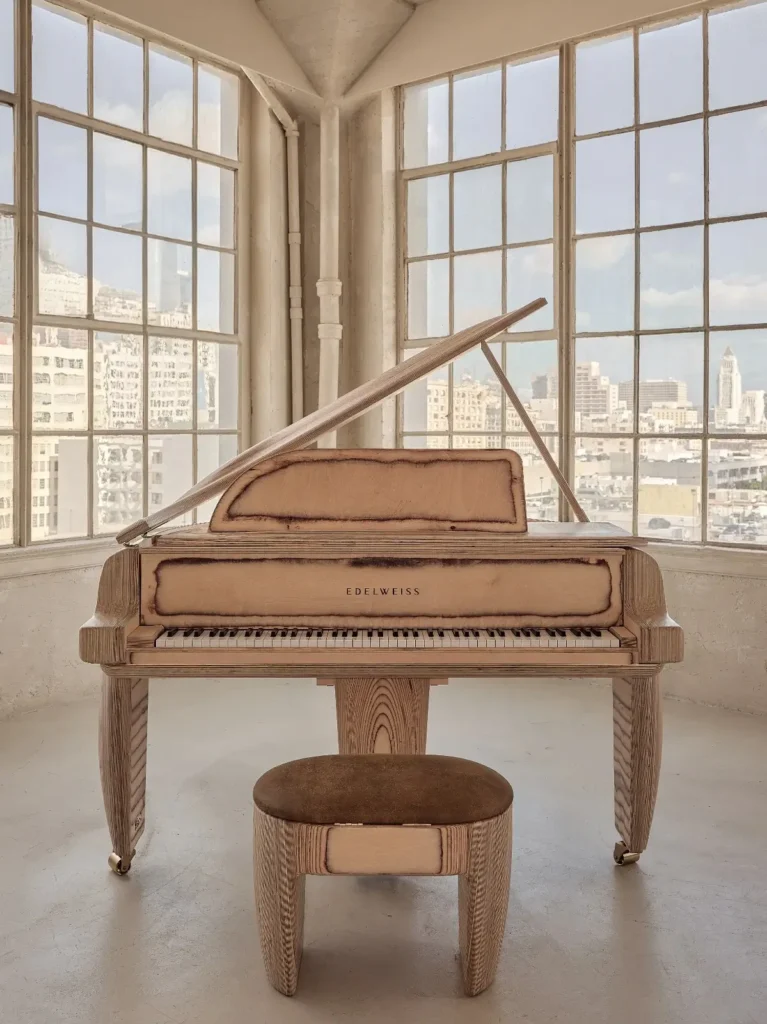
This shift aligns closely with Kelly Wearstler’s approach to interiors. Her work has consistently blurred the line between object and environment, where individual pieces are selected not only for their function, but for the role they play in shaping how a space is experienced. Within that context, the piano becomes something more than an instrument. It becomes part of the architecture of the room.
Timbrá sits comfortably within that world. Its form is considered from the perspective of the space first — how it is seen, how it is approached, how it holds attention without interrupting flow. It is conceived to exist within a room rather than apart from it, contributing to the visual language even in stillness. Whether placed within a private residence or a hospitality setting, it introduces a layer that is both sculptural and atmospheric.
In these environments, the piano is not always the focal point in the traditional sense. It doesn’t rely on performance alone to justify its role. Instead, it contributes quietly but consistently — shaping how the space feels, how it is used, and how it is remembered.
This is where its role has evolved. From instrument to something embedded within the space. From occasional features to an integral part of the room.
A piano is never entirely still.
Even in silence, it holds a kind of latent energy — a sense that it is waiting, ready to respond, capable of shifting the atmosphere of a space at any moment. It carries memory as much as it carries sound. The echo of what has been played. The anticipation of what might come next.
With Timbrá, that presence feels especially considered. It exists not as a static object, but as something that evolves with its surroundings. Light changes it. Movement around it changes it. Music, when introduced, transforms it entirely.
There is a quiet confidence in that kind of design. Nothing feels excessive, yet nothing is missing. The piano does not need to announce itself. It reveals itself gradually — through form, through material, through the way it inhabits the room over time.
In that sense, it becomes part of the rhythm of the space. Not just visually, but emotionally. A constant reminder that shapes how a room is experienced, whether in stillness or in sound.
And perhaps that is where its true value lies. Not only in what it does, but in what it creates — a shift in atmosphere, a change in perception, a subtle rebalancing of the room itself.