What to Look for When Buying a Self-Playing Grand Piano
Buying a self-playing grand piano is, for most people, a once-in-a-lifetime decision.
It is not the same as buying a sofa, or a television, or even a regular musical instrument. A grand piano of any quality is a long-term commitment — to a particular sound, a particular touch, a particular footprint in the room — and a self-playing grand carries an extra layer of decision-making on top of all of that. The instrument needs to perform on its own, and it needs to be a real piano you can sit down at and play.
It is worth taking the time to get this one right.
This is a practical checklist of what to look for when you are weighing up your options. It is written for the buyer who is standing in front of a piano they are considering — or about to be — and wants to know what to inspect, what to listen for and what to ask. It assumes you have already decided you want a grand rather than an upright. If you are still earlier in the process, our ultimate guide to self-playing pianos is the better starting point.
Before You Visit: What to Decide FirstAdd Your Heading Text Here
There are three things worth being clear on before you walk into a showroom.
How the piano will be used
This shapes almost everything else. A piano that will primarily play on its own — providing live music in the background of a room, at events, or simply because you love the experience — has slightly different priorities from a piano that will also be played by hand on a regular basis.
Both should be true grand pianos, but the balance shifts. If a real pianist will sit at the keyboard often, the action and the touch matter as much as the self-play system. If the piano is more of a self-playing instrument with the keyboard as a secondary feature, the resolution and music library of the system come further up the list.
Where it is going to live
The room matters. Grand pianos vary considerably in size, from baby grands of around 1.5 metres in length to concert grands approaching three metres. The piano’s footprint is only part of the picture. You also need to leave space around it — for the lid to open, for sound to project, for someone to walk around it, and for the bench. As a general rule, leave at least a metre of clearance on the keyboard side and ideally as much again behind the instrument.
Acoustics matter too. A piano in a room with hard floors and bare walls will sound very different from one in a heavily carpeted, soft-furnished room. There is no single right answer, but it is worth thinking about how the room will shape the sound before you commit to a particular size of instrument.
Your approximate budget
Self-playing grand pianos vary enormously in price, from mid-range factory-built instruments to bespoke hand-built grand pianos. Going into a showroom with at least a rough sense of where you sit on that scale will save you time and steer the conversation in a more useful direction. Our companion article on how much a self-playing piano costs breaks down the tiers in detail, including the ongoing costs many buyers forget.
The Piano Itself: What to Look At
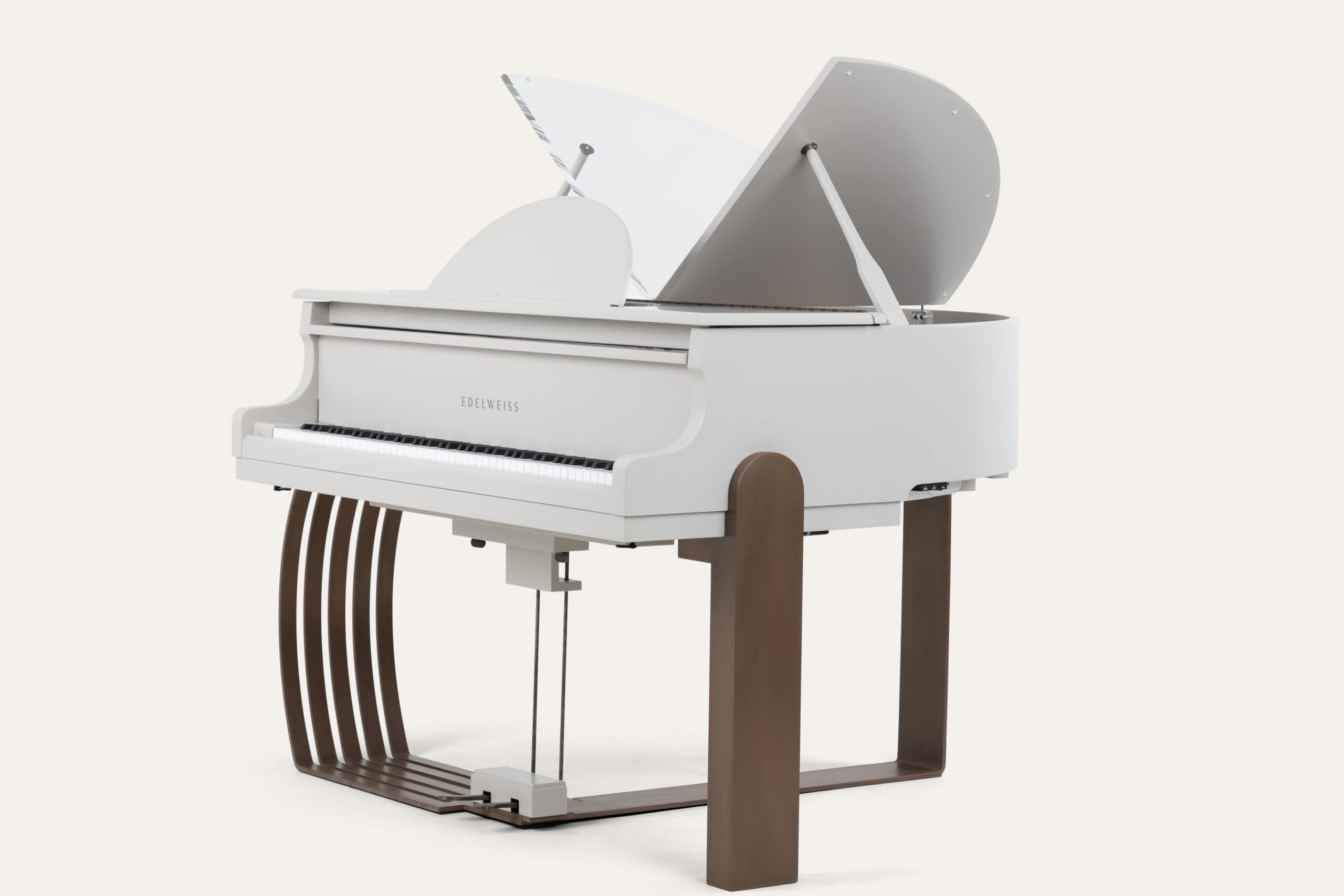
The most important thing to remember when buying a self-playing grand is that you are buying a piano first, and a self-playing system second. If the piano underneath is not a good instrument, no self-play system in the world will rescue it.
Here is what to look at.
The cabinet and case
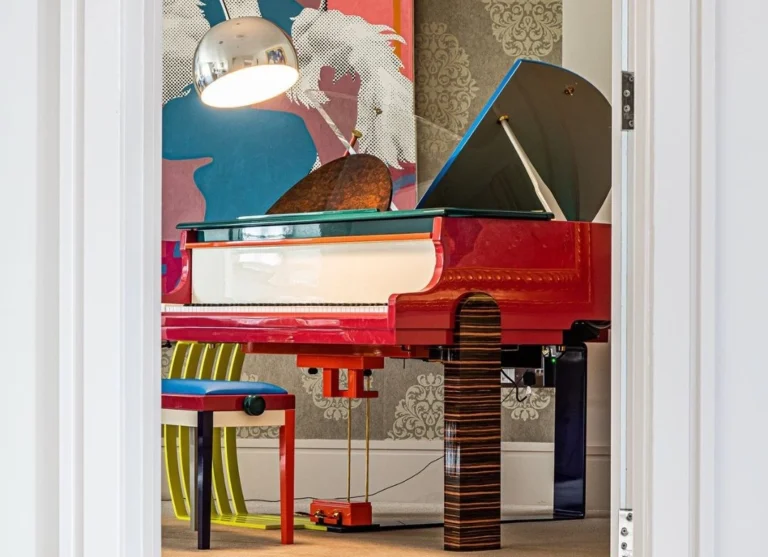
Walk around the piano. Look at the finish from different angles, in different light. Look at the joinery — particularly where the lid meets the rim, where the legs meet the case, and around the music desk. The standard of cabinet work tells you a great deal about the standard of the rest of the build. On a high-quality grand piano, the finish should be deep and consistent, with no orange-peel texture in the lacquer and no visible fillers along the joins.
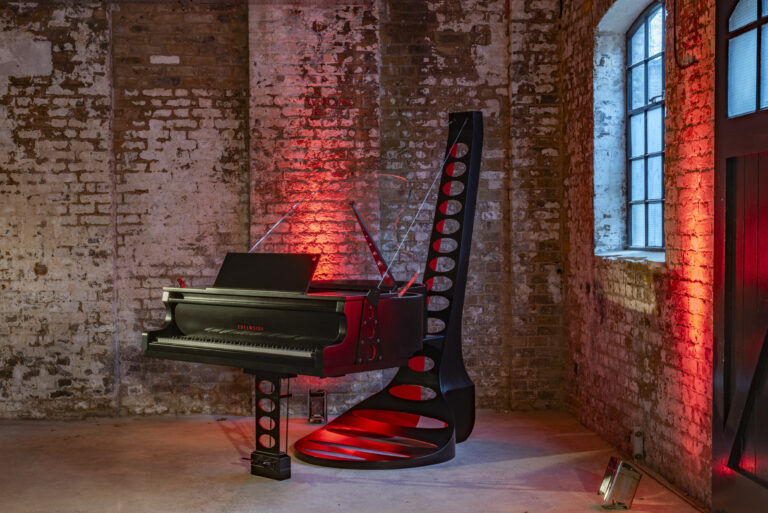
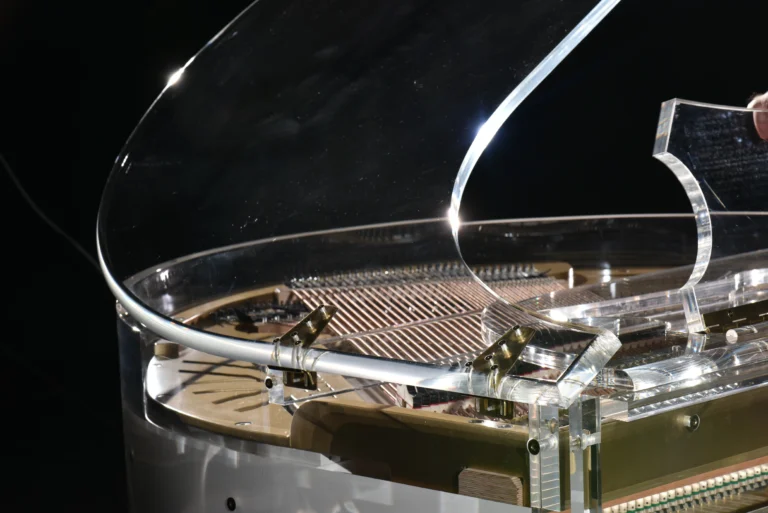
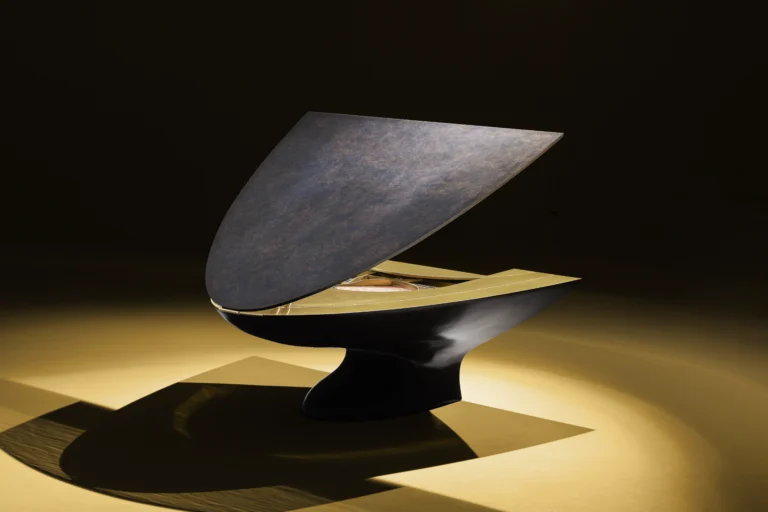
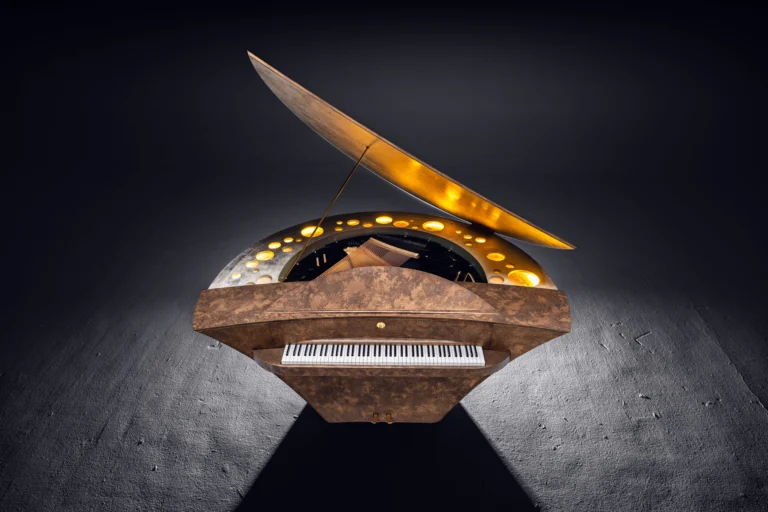
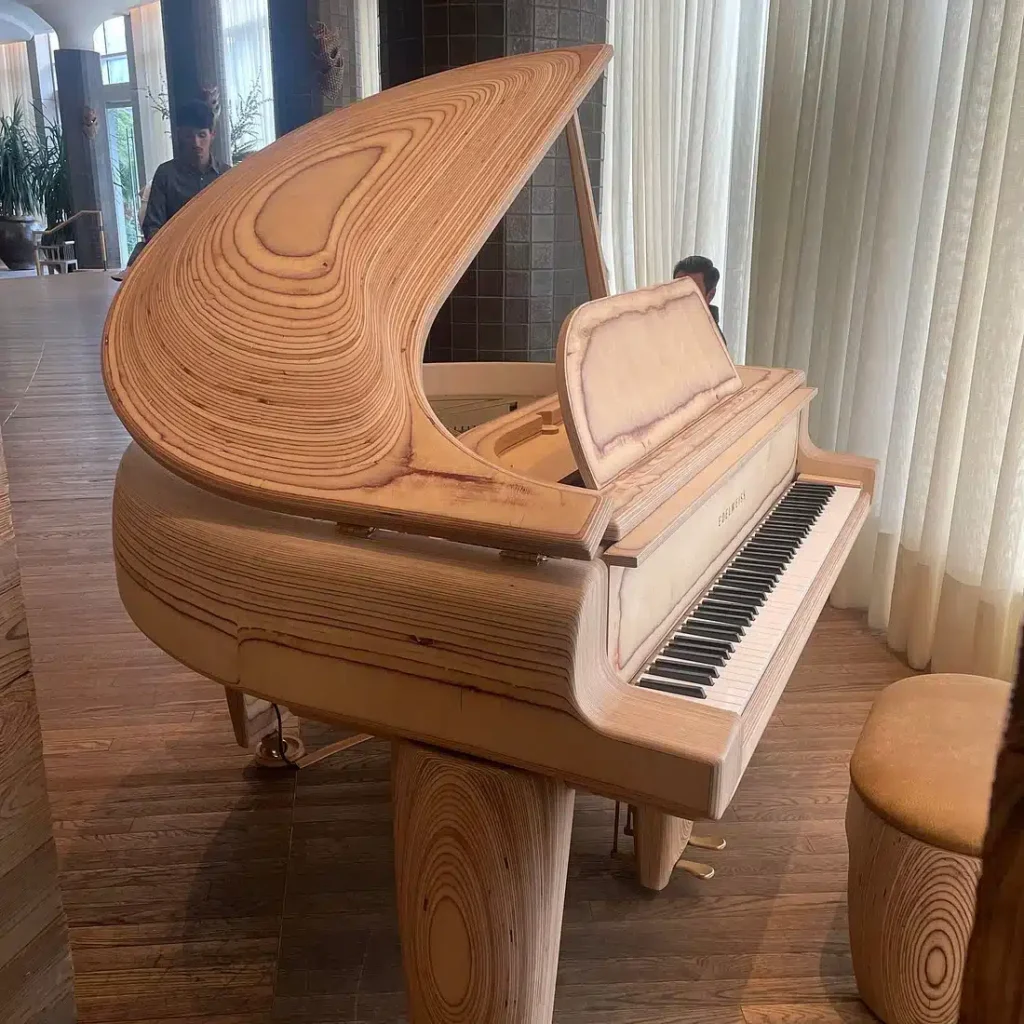
On a bespoke instrument, the cabinet is also where the design comes to life. Custom finishes, sculptural curves, transparent cases and integrated detailing all live at this level of the build. If you are commissioning a bespoke piano, the cabinet is where most of your conversations
The soundboard
The soundboard is the heart of an acoustic piano. It is the large wooden membrane beneath the strings that radiates the sound into the room. On any good grand piano it is made of solid spruce, with a slight upward curve called the crown, which gives the sound its projection and resonance.
If you are looking at a new piano, ask what the soundboard is made of and how it is constructed. If you are looking at a used piano, ask whether you can see the soundboard, and look for cracks. Small cracks are not always a problem — pianos are wooden instruments and minor splits can occur over time — but multiple cracks, separations, or soundboards that have been heavily repaired with shims are worth flagging to a technician.
Strings and bass winding
Look at the strings. They should be clean, evenly spaced and free of obvious rust. The bass strings — the thicker, copper-wound strings at the left of the instrument — are particularly important. On the best grand pianos, the bass strings are wound by hand using high-quality copper, spun on premium piano wire.
Edelweiss bass strings, for example, are made with hand-drawn copper spun on Röslau wire, the German-engineered wire used by many of the world’s leading piano makers. This level of detail is the kind of thing that tends to be visible only when you ask. It is worth asking.
The action
The action — the mechanism of levers, hammers, and dampers that translates a key press into a struck string — is, in the words of one piano technician, the engine under the hood. There are roughly 6,000 moving parts in a grand piano action, and the standard of those parts shapes how the piano feels under the fingers.
You cannot easily inspect the action visually without removing parts of the case, which is something a technician should do rather than the buyer. But you can feel it. Sit down and play. We will come back to this in more detail in a moment.
The pedals
Press all three pedals individually. Listen for squeaks or creaking. The right pedal — the sustain pedal — should lift the dampers cleanly and silently. The left pedal, on a grand, should shift the keyboard slightly to the right (this is the una corda effect). The middle pedal on a quality grand piano should be a true sostenuto: hold a note down, press the middle pedal, then release the note. The pedal should hold the original note while letting any subsequently played notes ring and damp normally.
If the middle pedal does not perform a true sostenuto on a grand, that is often a sign of a lower-quality instrument. Worth knowing.
Playing the Piano: What to Listen For
Even if you are not a pianist yourself, ask the dealer to play the piano, or to have someone else play it. Then, if you can, sit at it yourself.
Here are the things that genuinely matter.
Evenness across the keyboard
Play, or have someone play, a slow chromatic scale from the lowest note to the highest. Each note should sound consistent in volume, tone and response. Notes that are noticeably louder, quieter, brighter or duller than their neighbours suggest a piano that needs regulation or voicing — work that should ideally have been done before the instrument is offered for sale.
How softly the piano can play
This is one of the most revealing tests of any piano action. Play, or have someone play, the same note as quietly as possible, several times in a row. A well-regulated grand piano action should respond reliably even at a whisper. If notes drop out, miss, or play unevenly at very low volume, the action needs regulating.
Then play the same notes as loudly as the piano will go. The instrument should still feel controlled, not strained. The dynamic range — from the quietest pianissimo to the fullest fortissimo — is what gives a grand piano its expressive power, and it is what the self-play system will need to work with.
Sustain and resonance
Hold a single note in the middle register and listen. The sound should rise quickly, then sustain for several seconds before fading. A note that dies away within two or three seconds is a sign that the soundboard is not transferring vibration efficiently — usually because of cracks, glue failure or a soundboard that has lost its crown.
Play a chord and let it ring. The notes should blend, not fight each other. Listen for any rattles or buzzes, particularly in the bass. These can indicate loose hardware, sympathetic vibrations from elsewhere in the case, or — rarely but importantly — issues with the strings or bridge.
The character of the tone
This is the most subjective part of the test, and it matters enormously. Pianos have personalities. Some are bright and cutting, others warm and round, others silvery and clear. None of these is objectively right or wrong, but you will live with this voice for many years, so trust your own ear.
Play several pianos back to back if you can. The differences between two grand pianos of similar size and quality can be surprisingly large, and your preference will become obvious very quickly.
The Self-Play System: What to Investigate
Once you are happy with the piano underneath, the self-play system is what extends what it can do. The questions here are different from the ones you ask of the piano itself.
Resolution and dynamic range
Self-playing piano systems vary in how precisely they reproduce a performance. Lower-end systems read compressed MIDI files and trigger keys at a relatively coarse level of dynamic resolution. The most sophisticated modern systems measure key velocity at over a thousand discrete levels, with hundreds of pedal positions per second.
Ask the dealer how many gradations of force the solenoids can produce per key. The Edelweiss Virtuoso self-play system, for example, uses solenoids capable of more than 1,800 gradations of force, which is what allows the piano to move smoothly between a delicate pianissimo and a full fortissimo. The higher the resolution, the more convincingly the system can reproduce the nuance of a real pianist’s performance — something we explore in more depth in our piece on how self-playing pianos recreate a human performance.
The music library
Ask three things about the library. How many songs are included as standard. How is it organised — by genre, by artist, by mood — and how easy is it to find what you want. And how does the library grow over time. Some manufacturers include all future content within the purchase price. Others charge per song, per album, or via subscription. Edelweiss buyers, for example, receive a 1,000-song library as standard, with the option to expand to 5,000 songs and to commission custom recordings of specific pieces.
That last point matters more than people expect. A particular song — a wedding waltz, an anniversary piece, something that defines a family — is often the song that the piano gets played most often. If the library does not include it, ask whether it can be added.
How you control the piano
Most modern self-playing pianos are controlled wirelessly from a tablet. Pick up the tablet. Try the app. Is it intuitive? Can you find what you want quickly? Can you adjust volume, tempo and pacing easily? Is the app being actively maintained, with regular updates?
Worth asking: what happens if you misplace the tablet, or if the manufacturer’s app is one day discontinued? A good system should have a sensible answer to both.
Listen with the system off, then on
This is the test most people forget. Have the dealer play the piano normally, by hand, with the self-play system silent. Listen carefully — that is the piano. Then have them switch the system on and play the same piece, or something similar, with the keys moving on their own. The sound should be the same. The piano is the same instrument either way; only the source of the input has changed.
If the piano sounds different with the self-play system engaged, something is off. Ask why.
Can the piano still be played by hand?
It should be a yes, but check anyway. A self-playing grand piano should be a fully functional acoustic grand piano in every respect, with no compromise to the keyboard action when the system is engaged or disengaged. The self-play mechanism should sit beneath the keyboard without altering how the piano feels under your fingers.
Questions Worth Asking.
Some of the most useful questions are the ones the dealer is not expecting. Here are a few worth keeping in mind.
How is the piano built, and where?
There is a real difference between a production-line instrument and a hand-built one, and a real difference between pianos built in a small specialist workshop and those built in a large factory. Neither is wrong, but the answer tells you a great deal about what you are buying. Edelweiss pianos, for example, are hand-built in workshops in Cambridge, in the United Kingdom, with the Virtuoso self-play system fitted as standard to every piano that leaves the workshop.
What does the warranty cover, and for how long?
Warranty terms vary widely. Some cover the piano itself for a different length of time from the self-play system. Some cover parts but not labour. Some are transferable if you sell the piano on, others are not. Ask for the warranty in writing and read it before you commit.
How does delivery and installation work?
A grand piano is a complex thing to deliver. Ask who delivers it, whether the team is specialist piano movers, what is included in the delivery, and what happens if access at the property is awkward. Ask whether the price includes assembly on site, an initial tuning once the piano has settled, and any introduction or setup of the self-play system. For high-end and bespoke instruments, this is often a white-glove service handled directly by the manufacturer — but it is worth confirming rather than assuming.
How is the self-play system serviced and updated?
Like any technology, self-play systems are designed to evolve. Ask how the system receives updates, what happens when components age, whether the system is modular (so individual parts can be replaced rather than the whole system) and what the typical lifecycle of the technology looks like. A reputable manufacturer should design the system so that the technology can be maintained and upgraded without compromising the piano around it.
Can I see the piano in a real home, not just a showroom?
This is one of the most useful requests you can make. A piano in a showroom, with bright lighting and acoustic treatment, will sound and look different from the same piano in a domestic room. If the dealer can arrange a visit to an existing owner’s home — or if they have video of the piano in real-world settings — it will give you a much more realistic sense of what you are about to live with.
Practical Logistics: Things People Forget
A few last items that are easy to overlook in the excitement of choosing the piano itself.
Access to the room
Measure the route the piano will need to take to reach its final position. Doorways, corridors, staircases, lifts. A grand piano can usually be partially dismantled for delivery, but it is worth flagging tight spots to the dealer in advance. Sending an experienced piano mover to assess the route before the day of delivery is rarely a bad idea.
Power supply
Self-playing pianos need to be plugged in. The power requirement is modest, but the cable needs to reach somewhere sensible without being visible across the floor. Worth thinking about where the nearest socket is before the piano arrives, particularly if you are placing the instrument in the centre of a room.
Wi-Fi
Most modern self-playing pianos rely on Wi-Fi for control, library updates and streaming features. Make sure your network reaches the room where the piano will live. A weak or unreliable Wi-Fi signal will make the whole experience feel less seamless than it should.
Climate
Acoustic pianos are sensitive to humidity. A stable environment of around 42 to 55 percent relative humidity is ideal. Avoid placing the piano next to a radiator, an external wall that gets cold in winter, or in direct sunlight from a south-facing window. Conservatories are a particularly bad idea. None of this is unique to self-playing pianos, but it applies here just as it would to any high-quality grand.
A Final Thought
Buying a self-playing grand piano is, in the end, both a practical decision and an emotional one. The checklist above takes care of the practical side. The emotional side is harder to spell out, and it is the part that matters most.
Trust your ear. Trust your fingers. If you sit at a piano and find yourself reluctant to stand up, that is the piano telling you something. Conversely, if you walk away from a beautiful instrument with no real desire to come back, that is also information.
The right self-playing grand piano is the one that feels right to play, sounds right in the room and brings real music into your home for years to come — with or without anyone sitting at the keyboard. Take your time, ask the questions, listen carefully, and the right instrument tends to make itself known.